Gift to help SLCH, WashU develop care model to improve kids’ behavioral health (Links to an external site)

A $15 million gift from Bob and Signa Hermann will help establish the Hermann Center for Child and Family Development, housed within the Children’s Discovery Institute, a partnership between St. Louis Children’s Hospital and Washington University School of Medicine in St. Louis. A key aim of the center will be to adopt a transgenerational approach to reducing the burden of serious behavioral health conditions of childhood.

St. Louis Children’s Hospital and Washington University School of Medicine in St. Louis are tackling the issue of behavioral health support that has emerged as a leading health concern in our country — for people of all ages. The challenges of the COVID-19 pandemic have revealed the number of children suffering and how few resources are […]

Researchers unravel omicron’s secrets to better understand COVID-19 (Links to an external site)

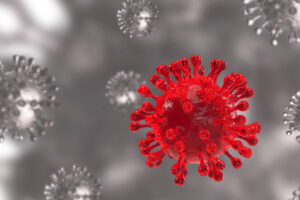
In two recent studies, researchers at Washington University School of Medicine in St. Louis found evidence that the omicron variant of the virus that causes COVID-19 causes less severe disease than previous variants — at least in rodents — but that many antibody-based therapies may not be effective against it. (Image: Getty Images)

When South African scientists announced in November that they had identified a new variant of the virus that causes COVID-19, they also reported two worrying details: one, that this new variant’s genome was strikingly different from that of any previous variant, containing dozens of mutations compared with the original virus that emerged in 2019; and […]

Researchers solve medical mystery of deadly illness in young child (Links to an external site)

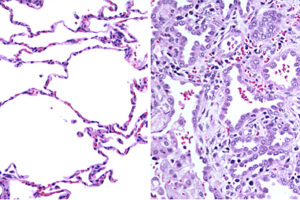
New research from Washington University School of Medicine in St. Louis has solved the medical mystery of why a 2-year-old child — seemingly healthy at birth — succumbed to an undiagnosed, rare illness. On the left is normal lung tissue showing air sacs with thin cell layers for the exchange of oxygen and carbon dioxide. On the right is the patient's lung tissue. Because of a mutation in the RAB5B gene, the walls of the air sacs are thick and unable to participate in gas transfer.

New research from Washington University School of Medicine in St. Louis has solved the medical mystery of why a 2-year-old child — seemingly healthy at birth — succumbed to an undiagnosed, rare illness. The research team identified a previously unknown genetic cause of interstitial lung disease, providing answers to the parents and doctors puzzled by […]

Diagnostic odyssey (Links to an external site)

Jason and Amy Lair with their son, James, 8, on the family farm near Alexis, Ill. The Undiagnosed Diseases Network discovered a genetic variant that inhibits James’ growth.

When you seek medical care, you expect a diagnosis. You may need to answer a lot of questions and undergo tests, but usually doctors can figure out the root of the problem.

Drug mimics beneficial effects of fasting in mice (Links to an external site)

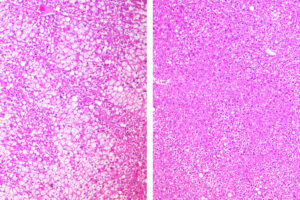
An investigational cancer drug that starves tumors of their energy supply also shows evidence of improving whole body metabolism, according to a new study in mice from Washington University School of Medicine in St. Louis. Shown are sections of liver from mice on a high-fat, high-sugar diet. On the left, more white space indicates greater fat accumulation in an untreated mouse. On the right, in a mouse treated with the drug, the liver shows less fat accumulation.

An investigational cancer drug that starves tumors of their energy supply also shows evidence of improving whole body metabolism, leading to improved weight control, according to a new study in mice from researchers at Washington University School of Medicine in St. Louis.

Study examines risk factors for severe health problems in kids with COVID-19 (Links to an external site)

An international study involving researchers at Washington University School of Medicine in St. Louis analyzed the risk factors for serious health outcomes in kids who had COVID-19. Researchers found that children up to age 18 who had tested positive for COVID-19 were at low risk for severe health problems. The study was based on pediatric data analyzed up to June 2021, before the delta and omicron variants took hold.

An international study involving researchers at Washington University School of Medicine in St. Louis found that children up to age 18 with COVID-19 were at low risk for serious health problems stemming from such infections. The study was based on pediatric data analyzed up to June 2021, before the delta and omicron variants took hold.

New treatment target ID’d for radiation-resistant cervical cancer (Links to an external site)

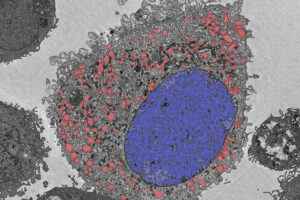
Two new studies from Washington University School of Medicine in St. Louis have identified a previously unrecognized pathway of cell death — named lysoptosis — and demonstrate how it could lead to new therapies for cervical cancer. Pictured is a human cervical cancer cell that is undergoing lysoptosis triggered by radiation. The cell is missing a key gene that protects against this type of cell death, making the cell easier to kill with radiation and chemotherapy. Lysosomes are shown in red. The cell nucleus is in blue.

Understanding how cells die is key to developing new treatments for many diseases, whether the goal is to make cancer cells die or keep healthy cells alive in the face of other illnesses, such as massive infections or strokes. Two new studies from Washington University School of Medicine in St. Louis have identified a previously […]