Cellular housekeeping process implicated in fatal neurological disorder (Links to an external site)
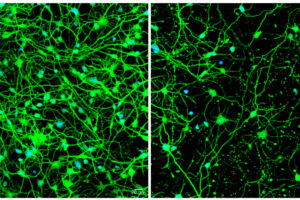
A study from Washington University School of Medicine in St. Louis shows that as patients age, Huntington's disease impairs autophagy, which eliminates waste from cells. Shown at left are neurons transformed from skin cells of a young patient with pre-symptomatic Huntington's disease. On the right are neurons transformed from skin cells of an older patient with symptomatic Huntington's; these cells are sparse because the aging process impairs autophagy, leading to cell death.

Huntington’s disease, a fatal, inherited neurodegenerative condition, is caused by a genetic error present at birth, though its symptoms often don’t begin until middle adulthood. Scientists at Washington University School of Medicine in St. Louis have been trying to understand how the aging process triggers the onset of symptoms, with the expectation that such knowledge […]

First of its kind DeSanto-Shinawi Syndrome clinic takes place at St. Louis Children’s Hospital

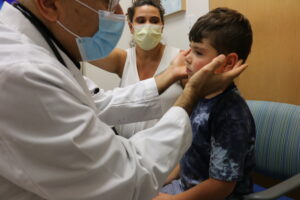
Marwan Shinawi, MD, feels Leo's lymph nodes during first-ever DeSanto-Shinawi Syndrome clinic on Sept. 29, 2022, at St. Louis Children's Hospital.

A first of its kind clinic has parents and medical professionals alike excited. The inaugural DeSanto-Shinawi Syndrome clinic took place on Sept. 29-30 at St. Louis Children’s Hospital. It was the first clinic of its kind in St. Louis for the syndrome that was described by Washington University pediatrician Cori DeSanto, MD, and Washington University […]

Testing Inclusivity and Innovation Benefits All (Links to an external site)

Masked children in classroom

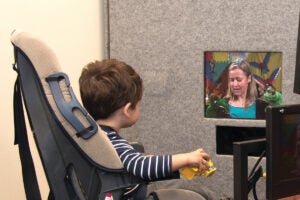
When the COVID-19 pandemic struck in the spring of 2022, students and staff at schools that serve children with intellectual and developmental disabilities (IDD) were left stranded. These students and staff faced unique circumstances because they could not always follow the CDC guidance on masking, testing, and social distancing due to the nature of these […]

New way viruses trigger autoimmunity discovered (Links to an external site)

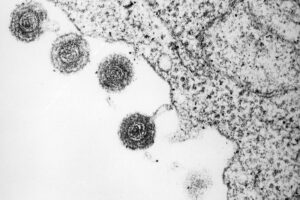
Roseolovirus particles emerge from an infected immune cell (above). Studying mice, researchers at Washington University School of Medicine in St. Louis have discovered that roseolovirus can trigger autoimmunity in a previously unknown way: by disrupting the process by which immune cells learn to avoid targeting their own body's cells and tissues.

Autoimmune diseases such as rheumatoid arthritis and Type 1 diabetes are thought to arise when people with a genetic susceptibility to autoimmunity encounter something in the environment that triggers their immune systems to attack their own bodies. Scientists have made progress in identifying genetic factors that put people at risk, but the environmental triggers have […]

Antibiotic doesn’t prevent future wheezing in babies hospitalized with RSV (Links to an external site)

Antibiotics provide no benefit in preventing future recurrent wheezing in babies hospitalized with respiratory syncytial virus (RSV), according to a new study led by Washington University School of Medicine in St. Louis. And there is some evidence that antibiotics may make wheezing worse.

The antibiotic azithromycin has anti-inflammatory properties that can be beneficial in some chronic lung diseases, such as cystic fibrosis. With that in mind, researchers investigated its potential to prevent future recurrent wheezing among infants hospitalized with respiratory syncytial virus (RSV). With such babies at increased risk of developing asthma later in childhood, the scientists hoped […]

Researchers unravel omicron’s secrets to better understand COVID-19 (Links to an external site)

In two recent studies, researchers at Washington University School of Medicine in St. Louis found evidence that the omicron variant of the virus that causes COVID-19 causes less severe disease than previous variants — at least in rodents — but that many antibody-based therapies may not be effective against it. (Image: Getty Images)

When South African scientists announced in November that they had identified a new variant of the virus that causes COVID-19, they also reported two worrying details: one, that this new variant’s genome was strikingly different from that of any previous variant, containing dozens of mutations compared with the original virus that emerged in 2019; and […]